
<<<<<<<<<<<<<<<<<<<<<<<<<<<<<<<<<<<<<<<<<<<<<RETEP
How do anarchists dance?
Benjamin Pohlig and PETER explore the question:
“How do anarchists dance?”
Dancing anarchist manifesto –
The dancing anarchist, how does an anarchist dance?
Anarchy is free of domination
Non-governable, indifferent to governance, meaning it is not recognised. Think of the baby or the animal, they can’t be governed because it is foreign to them, they can only be dominated, un-governed and struggle against control, or non-governable completely without an understanding of governance.
Dancing needs to escape domination, in order to be non-governable. It works both ways if the dominated know they are being dominated all they can do is be governed or ungovernable, but it’s not possible to govern what is not known. And it is here that I believe dancing can escape domination.
If the dancing anarchist can hide their dancing from governance they and their dance can be non-governable.
So when they forget the logic of governance. Get lost in the dancing. This can hide from self-governance.
However, an activity often only feels like dancing because of our relations to it. We experience it as dance simply through how we relate to what we are doing. So if we can find hidden affinities, relations which can hide their activity from domination then they too can be removed from the relationship to governance, and become indifferent to it, and be non-governable.
But it is important that these secret affinities stay a secret in order to be non-governable. Which means you mustn’t talk about them outside the secret affinity. This silence relies entirely on trust, a trust in keeping unknown the anarchist dancing from domination.
But this doesn’t mean the dancing can’t be seen by people outside the affinity, only that it can’t be shown. This is how secret affinities between dancing anarchists can exist without any verbal agreement. When the dancing is known by those outside the affinity to be non-governable it can only be un-governable at best. Becoming a protest against in order to not be governed.
Ungovernable dancing, dancing for or against something, a protest dance, isn’t a bad thing but it dances within the sight of governance and can never relax until it’s being, until it is non-governable dancing and escapes domination. Otherwise when it is known by governance it can only be governed, or un-governable, dominated.
But if the affinity can be kept a secret from governance, if it can be unknown to governance then it can remain non-governable. This is why the dancing anarchist can be seen but not known. So we can do anything, absolutely anything if we find affinities and keep them a secret.
So the anarchists can’t dance for you, but hidden you may become a dancing anarchist.
Dancer, choreographer, audience are all visible activities subjected the domination within dancing. The dancer dominates through their possession of the dancing, the choreographer dominates through the authority over the dancing, and the audience through the divorce from the dancing. Dominating not only each-other but also themselves. They can each only protest with this visibility.
It may be useful to think of the anarchism of dancing as something when in a society of governance and domination, as something that just pops up all the time. It emerges in the shadows of the known and knowable. It keeps things alive, plastic, changeable, creative and critical. It may be that it’s the very condition for change living in the shadows of should’s and ought to be’s, moving in and out of the shadows. Becoming visible and then returning again.
Affinity is friendship, recognition, being with, staying a little longer. A clandestine movement.
Recognizing this means, within the ungovernable spaces we find ourselves, we must advocate for plastic institutions. Freedom of association, mutual aid, direct democratic decision making. We must advocate against domination, because we believe and imagine that the non-governable exists.
We must believe in the dancing anarchists. We must fight against domination, and for the un-governable within dance and, hide from domination the non-governable in our dancing. We may never know the dancing anarchist but we may be dancing with anarchy.

Script – 27th May 26
We have been reseaching the question “how do anarchists dance?”
And in the face of domination the dancing anarchist can not be known.
Because of the nature of the question, rather than showing what we have been doing, we wanted to invite you to join us.
So let’s start by saying the dance is offically cancelled. We have no plan. So don’t dance and if you felt like you are dancing do something else.
You can walk around, you can sit, lie down, close your eyes, speak to eachother, ask questions, avoid questions, sing, you can leave the room, go toilet, you can do anything you want, you can even dance.
so what if, you start moving and you call it anarchy?
The dancing anarchist must stay hidden from domination.
They may be dancing in relation to someone or something else, but only hidden from the sight of domination.
So I can’t tell you, or show you where the anarchist is dancing.
The anarchist creates seceret affinities unknowable to domination.
You could already be in a seceret affinity, you could already be an anarchist dancing.
so what if, you start moving and you call it anarchy?
Remember this dance doesn’t have to exist.
Stay safe, no justice no peace
We are going to get lunch now.
with support from MARC (Milvus Artistic Research Center) and DansiT Koreografisk senter / Choreographic Center.


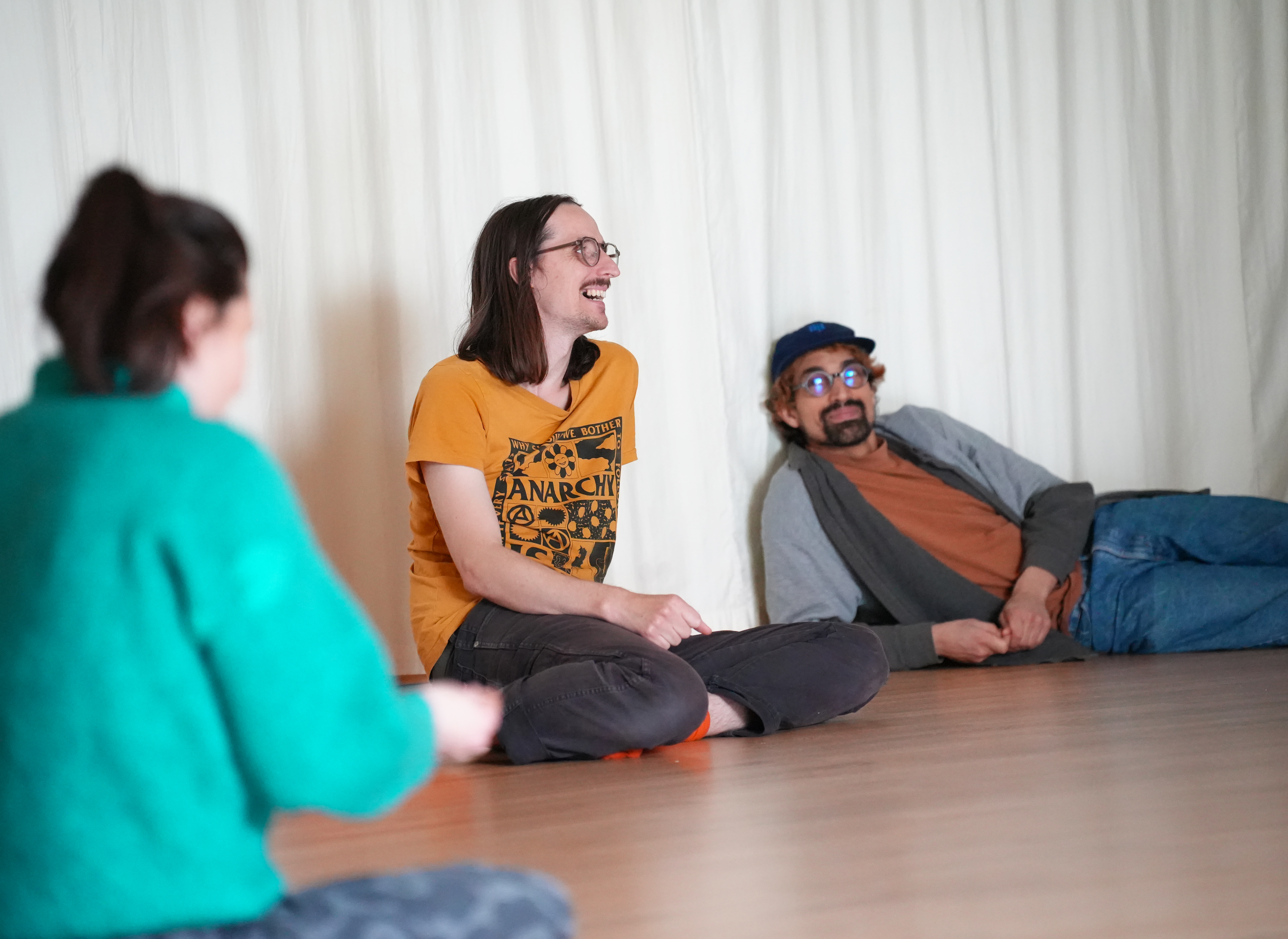

Credit: Ingvil Snøfugl/DansiT
REFFERNCES
Malabou, Catherine. Stop Thief! Anarchism and Philosophy. Translated by Carolyn Shread. Cambridge: Polity Press, 2023
Bigé, Emma. “Danser l’Anarchie: théories et pratiques anarchistes dans le Judson Dance Theater, Grand Union et le Contact Improvisation.” Revista Brasileira de Estudos da Presença 10, no. 1 (2020). https://doi.org/10.1590/2237-266089064.
Stilinović, Mladen. “The Praise of Laziness.” Translated by Marija Marušić. Agosto Foundation, 1993. https://agosto-foundation.org/the-praise-of-laziness.
Rojo, Paz. To Dance in the Age of No-Future. Circadian Books, 2019. Part of the doctoral exposition The decline of choreography and its movement: a body’s (path)way, Stockholm University of the Arts (X-position nr. 5). https://www.researchcatalogue.net/view/727172/727185.
Malabou, Catherine. “Is the Unconscious an Anarchist?” Interview by CRMEP Podcasts. SoundCloud, 2024, https://soundcloud.com/user-455945207/is-the-unconscious-an-anarchist-catherine-malabou.
Anarchist Federation and Red and Black Leeds. “Work.” The Anarchist Library, 2015. https://theanarchistlibrary.org/library/anarchist-federation-of-britain-work.
D’Souza, Aruna. “When post-irony renders real and fake indistinguishable, irreverence becomes a political weapon.” Document Journal, October 10, 2024. https://www.documentjournal.com/2024/10/when-post-irony-renders-real-and-fake-indistinguishable-irreverence-becomes-a-political-weapon/.
Malabou, Catherine. “Being an Anarchist.” Translated by Carolyn Shread. The Anarchist Library, 2023. https://theanarchistlibrary.org/library/catherine-malabou-being-an-anarchist.